The Day the Mailbox Exploded (Almost)
Picture the Millers. They live in a lovely cul-de-sac in Orange County, two kids, a friendly golden retriever named Sunny, and a perfectly manicured lawn. They’ve got good jobs, a nice house, two cars – the whole California dream. One Tuesday morning, a letter arrived. Not a bill, not junk mail. A notice from their homeowners insurance. Their policy, it said, was renewing, but with a catch: to keep their existing coverage, they’d need to raise their personal liability limits. A lot.
“What in the world is personal liability?” Sarah Miller asked her husband, Tom, over breakfast. Tom just shrugged, scrolling through the news on his phone. They thought they were covered for everything. Didn’t their home insurance protect them? Didn’t their auto policy? The short answer is yes. The real answer is more complicated, especially in California, where one bad day can unravel years of hard work.
That letter was a gentle nudge, a hint that their standard insurance wasn’t quite enough for the modern risks of living here. It was pointing them, indirectly, toward something called umbrella insurance. Most people hear “umbrella” and think it’s only for the super-rich, the folks with multiple mansions and yachts. Not true. Not anymore.
What Umbrella Insurance Is, Really
Think of your home and auto policies as buckets. They hold a certain amount of protection. Your auto insurance might cover $250,000 per person, $500,000 per accident. Your homeowners policy might have a $300,000 liability limit. Those are big numbers, right? For most fender-benders or a minor slip-and-fall, they’d probably do the trick.
But here’s where it gets interesting. What happens when the bucket overflows? What if Sunny, the friendly golden retriever, has a really bad day and bites the neighbor’s kid, requiring extensive surgery and causing permanent damage? Or what if Tom, distracted by a text (which he knows he shouldn’t be doing!), causes a multi-car pile-up on the 405 that injures several people, including a neurosurgeon who can no longer perform surgery? Suddenly, those $500,000 limits don’t look so big.
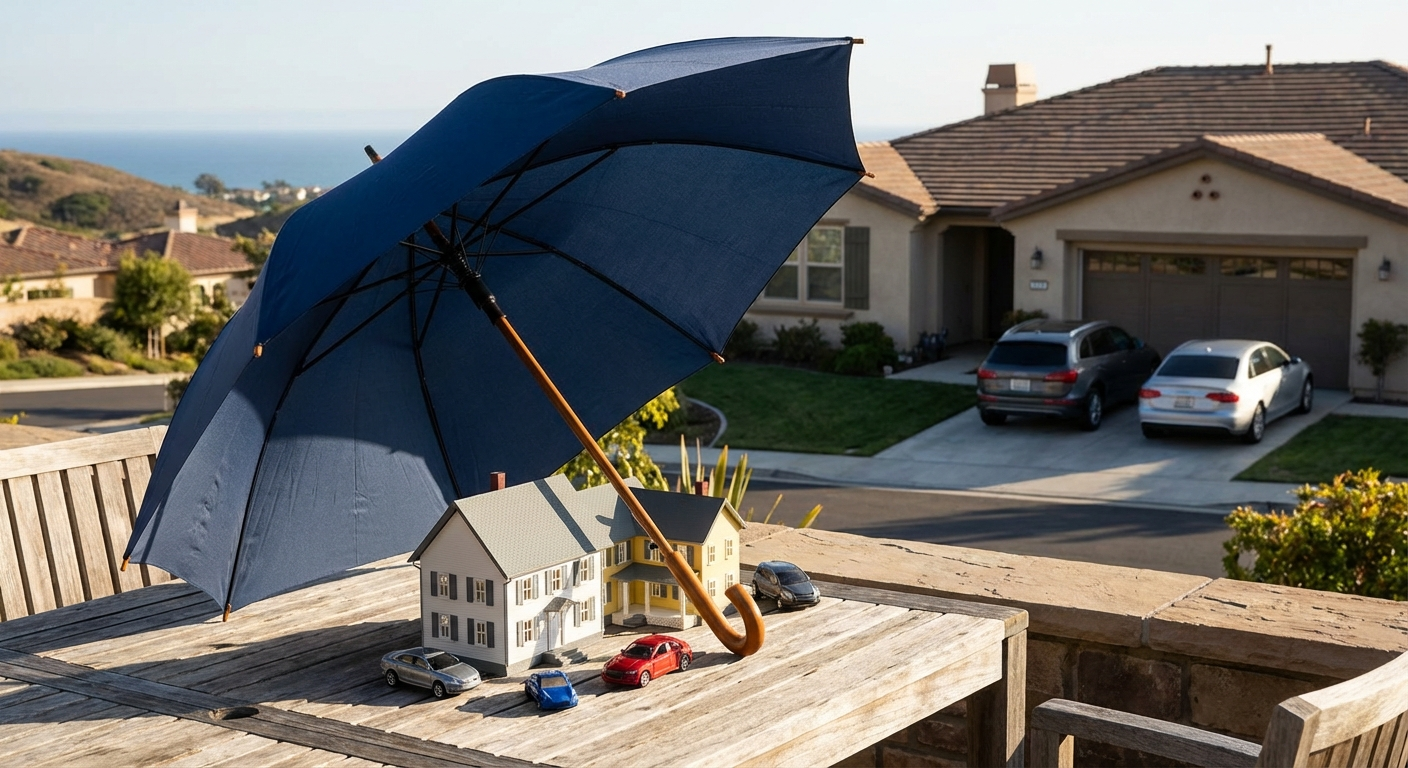
An umbrella policy is like a giant, extra-deep bucket placed *above* your existing insurance. When your primary policies hit their limits, the umbrella kicks in, covering the rest — sometimes up to millions of dollars. It protects you from claims that could otherwise wipe out your savings, your investments, even your home equity. It’s a shield for your entire financial life.

Why Californians Need It More Than Most
California isn’t just a place with beautiful beaches and stunning mountains; it’s also a place with high property values and a very litigious culture. People sue. A lot. And when they do, they often go after what they perceive as “deep pockets.” If you own a home in Ventura County or have substantial savings, you’re a target.
Consider the everyday risks:
* **Car accidents:** Our freeways are notoriously busy. A single accident on the 101 or the 5 can involve multiple vehicles and serious injuries. Medical costs here aren’t cheap.
* **Property liability:** That backyard pool in Encino? It’s fun, but it’s also a serious liability risk. A guest slips, falls, and breaks their neck. Or a child drowns. Your home insurance might cover a few hundred thousand, but a catastrophic injury or wrongful death lawsuit can easily soar into the millions.
* **Dog bites:** Even the sweetest dog can snap. California sees a lot of dog bite claims. And when a child is involved, the emotional and physical damages can be immense.
* **Reputational harm:** Did you know an umbrella policy can also cover claims for libel, slander, or defamation? A casual post on social media that goes wrong could land you in hot water.
Then there’s the broader insurance picture in California. Our market has seen some turbulence. Premiums for all sorts of policies jumped between 2022 and 2024, sometimes by 40% or more, depending on the insurer and location. Some carriers have pulled back from the state, especially in areas prone to wildfires, which only makes finding good coverage — and understanding what you truly need — even more pressing. Prop 103, while designed to protect consumers, has also added layers of complexity to how rates are set and policies are approved, sometimes leading to less choice.
How Umbrella Insurance Works with Your Other Policies
Here’s the key: umbrella insurance isn’t a standalone product. You can’t just buy an umbrella policy without having underlying home and auto insurance. Insurers offering umbrella coverage demand that you maintain certain minimum liability limits on those primary policies. This isn’t a state law or some arbitrary rule; it’s how the system works.
For most insurers, these underlying limits typically look something like this:
* **Auto liability:** $250,000 per person / $500,000 per accident for bodily injury, and $100,000 for property damage.
* **Homeowners liability:** $300,000 or $500,000 for personal liability.
Why do they insist on these higher primary limits? Because they want your underlying policies to handle the bulk of smaller, more common claims. The umbrella is there for the truly catastrophic events, the “black swan” incidents that blow past those initial limits. It’s a way for them to share the risk and ensure you have a strong first line of defense. The Millers’ renewal letter, asking them to bump up their liability limits, was their insurer signaling exactly this.
The “Requirements” Aren’t Rules — They’re Smart Choices
Let’s be clear: no California state law *requires* you to carry umbrella insurance. Unlike auto insurance, which is mandatory here, an umbrella policy is optional. But that’s not the whole story. While the state doesn’t mandate it, insurance companies *will* require you to meet specific underlying liability thresholds on your home and auto policies if you want to purchase an umbrella policy from them. It’s their condition for extending that extra layer of protection.
Think of it like this: you want to build a really tall tower of blocks. You need a solid, wide base for it to stand securely. Your primary policies are that base. If your base is too small or wobbly, the tower — your umbrella policy — won’t be stable, and the insurer won’t sell it to you. These “requirements” have even shifted over time. Years ago, lower underlying limits might have been acceptable. But with rising medical costs, increased litigation, and higher jury awards, those baseline requirements have steadily gone up.
Common Scenarios Where an Umbrella Saves the Day
The Millers, after some research, realized their standard coverage was pretty flimsy for their California life. Here are some situations where an umbrella policy really shines:
* **The Dog Bites:** Remember Sunny? If he had bitten the neighbor’s child, and the medical bills, reconstructive surgery, and pain and suffering tallied up to $750,000, their $300,000 homeowners policy wouldn’t have been enough. The umbrella could pick up the remaining $450,000.
* **The Car Crash:** Tom’s hypothetical multi-car pile-up on the 405 results in $1.5 million in bodily injury claims. His auto policy maxes out at $500,000. That’s a $1 million gap. Without an umbrella, the Millers’ home, savings, and future earnings could be on the line. With it? That $1 million is covered.
* **The Pool Party Gone Wrong:** A friend’s child at their Encino home suffers a severe injury near their pool, leading to a multi-million dollar lawsuit. Their $500,000 home liability policy is exhausted quickly. The umbrella steps in.
* **Social Media Snafu:** Sarah posts a passionate, but ultimately untrue, comment about a local business owner online. The owner sues for defamation and wins a hefty judgment. An umbrella policy can even cover these types of personal injury claims that don’t involve physical harm.
* **Teen Driver Trouble:** The Millers’ oldest, Emily, gets her license. Teen drivers, even careful ones, are a higher risk. If Emily causes a serious accident, the financial fallout could be devastating. An umbrella policy extends protection to all household members.
Finding the Right Fit in the Golden State
Finding the right umbrella policy in California isn’t always as simple as clicking a button. Not all policies are created equal, and not every insurer offers the same terms or even the same underlying limit requirements. Some major carriers like State Farm, AAA, and Farmers offer umbrella policies, but their pricing and conditions can vary widely.
This is where an independent insurance agent becomes invaluable. They work with multiple carriers, not just one, and can help you compare options to find the best fit for your specific needs and budget. Someone like Karl Susman at Los Angeles Umbrella Insurance, CA License #OB75129, has seen it all. He understands the unique risks Californians face and can guide you through the maze of policies. He’s helped countless families, from the Valley to the Inland Empire, secure the protection they need.
If you’re wondering what an umbrella policy might look like for you, it’s worth getting a personalized quote. You can explore your options and see how affordable this crucial coverage can be. Get a quote today and protect your future: https://losangelesumbrellainsurance.com/quote/
The Cost: What Drives Umbrella Premiums
You might think an extra million dollars of coverage would cost an arm and a leg. Often, it doesn’t. Compared to your underlying home and auto premiums, umbrella policies are surprisingly affordable. Most people can get a million dollars in coverage for a few hundred dollars a year.
What makes the premium go up?
* **The amount of coverage:** More millions mean a slightly higher premium.
* **Number of homes:** If you own a second home in Palm Springs, that adds to the risk.
* **Number of cars and drivers:** More vehicles and more drivers, especially young ones, increases potential liability.
* **”Attractive nuisances”:** Things like swimming pools, trampolines, or certain dog breeds (like Rottweilers or pit bulls, which some insurers view as higher risk) can raise your premium.
* **Your claims history:** A history of previous claims, even minor ones, can influence rates.
* **Your location:** Living in a dense urban area like Los Angeles versus a quieter community can impact perceived risk.
While premiums have generally risen across the board for all types of insurance in California, umbrella policies remain a relatively cost-effective way to get significant peace of mind.
What Happens if You Don’t Have It?
The Millers, after their initial scare, decided to get an umbrella policy. Good thing, too. A few months later, their daughter Emily, a new driver, tapped the bumper of a vintage Porsche in a parking lot. Minor damage to the Porsche, but the owner insisted on specific, very expensive repairs. Their auto policy covered it, but it was a reminder of how quickly things can escalate.
What if Emily had caused a serious accident with injuries? Without an umbrella policy, any judgment against them that exceeded their primary insurance limits would come directly from their personal assets. That means their savings, their investments, the equity in their Orange County home — all could be fair game. Future earnings could even be garnished. That’s why an umbrella policy isn’t just about covering claims; it’s about protecting everything you’ve worked so hard for. It helps you sleep at night.
If you’re a California homeowner, a small business owner, or simply someone with assets to protect, it’s a smart move to look into umbrella insurance. Don’t wait for a letter in the mail, or worse, a lawsuit, to realize your coverage isn’t enough. Talk to an expert who understands the California landscape. Karl Susman and his team at Los Angeles Umbrella Insurance, CA License #OB75129, are available to answer your questions at (877) 411-5200.
Take the first step toward securing your financial future. Find out how an umbrella policy can provide the robust protection you deserve: https://losangelesumbrellainsurance.com/quote/
Frequently Asked Questions About California Umbrella Insurance
Do I really need umbrella insurance in California if I have good home and auto policies?
Yes, probably. While your home and auto policies provide a good foundation, they have limits. In California’s litigious environment, with high medical costs and property values, it’s easy for a serious claim to exceed those limits, leaving your personal assets exposed. An umbrella policy acts as an extra layer of protection, usually starting at $1 million.
What are the typical underlying policy limits required for an umbrella policy in California?
Most insurers in California will require underlying auto liability limits of at least $250,000 per person / $500,000 per accident for bodily injury and $100,000 for property damage. For homeowners insurance, a personal liability limit of $300,000 or $500,000 is common. These aren’t state laws, but insurer requirements to offer you an umbrella policy.
Does an umbrella policy cover everything?
Not everything. It generally covers personal liability claims like bodily injury, property damage, libel, slander, and false imprisonment. It does *not* cover your own injuries or property damage (that’s what health, auto collision, and home insurance are for), nor does it cover business losses or intentional criminal acts.
Is umbrella insurance expensive in California?
Compared to the significant protection it offers, umbrella insurance is often surprisingly affordable. A $1 million policy can cost just a few hundred dollars a year for many people. The exact cost depends on factors like your location, the number of properties and vehicles you own, and your claims history.
Can I get umbrella insurance from a different company than my home and auto insurance?
Sometimes, yes. While it’s often simpler and sometimes more affordable to bundle your umbrella policy with your existing home and auto insurer, it’s not always a requirement. Many independent insurance agents, like Karl Susman, can help you explore options from different carriers to find the best solution for you, even if it means placing your umbrella with a separate company.
This article is for informational purposes only and does not constitute financial advice.